How & Why Is Stochastic Violence Encouraged By Trump?
Power, Plausible Deniability, and the Economics of Fear

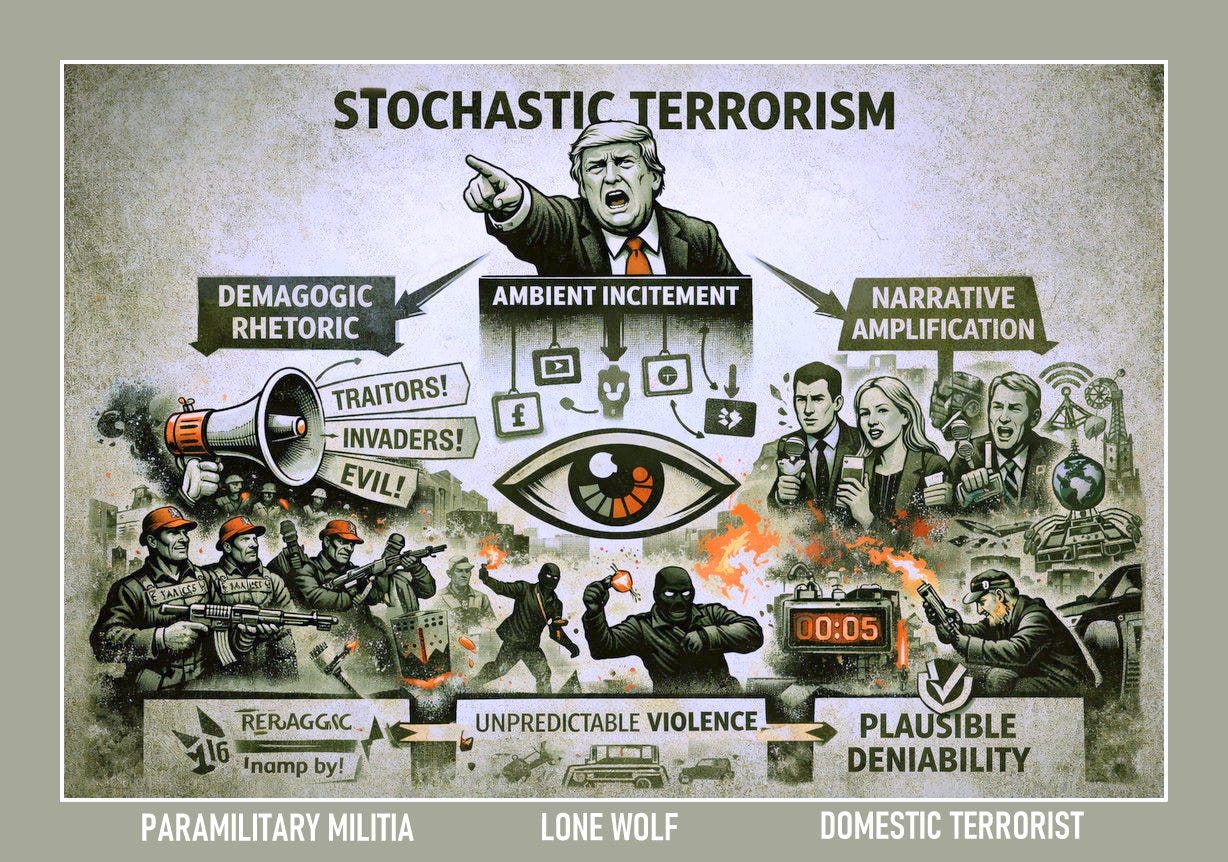
Stochastic political violence does not arise from explicit orders. It emerges from atmospheres deliberately engineered—rhetorical climates in which violence becomes statistically likely while responsibility remains diffuse.
In recent American politics, Donald Trump, allied media ecosystems, wealthy patrons, and segments of the Republican Party have repeatedly contributed to a climate of Stochastic Terrorism.
The reasons are not mysterious; they are strategic.
At its core, stochastic terrorism and violence is a tool of asymmetric power. It allows elites to mobilize fear and coercion without assuming legal or moral liability. The mechanism is simple: relentless framing of opponents as existential threats—traitors, vermin, invaders, enemies of the nation—combined with glorification of “strength,” “retribution,” and “patriotism.”
No command is issued. Yet the probability that someone, somewhere, will act violently rises. The match is never struck by the architect; the tinder is merely piled high.
Why would powerful actors tolerate—or even encourage—this?
First, it stifles democracy without suspending it outright. Elections, courts, and legislatures remain formally intact, but participation becomes hazardous. Election workers resign. Judges require protection. Journalists self-censor.
Ordinary citizens retreat from civic life. The chilling effect is real, measurable, and politically useful.
Second, it creates loyalists bound by shared transgression. Once a movement tolerates or rationalizes violence, its members become mutually implicated. Silence becomes complicity; dissent becomes betrayal. This hardens in-group identity and immunizes leaders against scandal.
Hypocrisy loses its sting because moral norms have already been degraded.
Third, it is economically efficient for oligarchic interests. Large concentrations of wealth depend on regulatory paralysis and public distraction. Culture war and perpetual crisis keep attention away from tax policy, antitrust enforcement, labor rights, and environmental regulation.
Violence—sporadic, shocking, but deniable—functions like background radiation: harmful, omnipresent, and normalized. Markets prefer predictability; oligarchs prefer distraction.
Fourth, plausible deniability is preserved. Leaders can condemn violence abstractly while continuing the rhetoric that makes it likely.
When an attack occurs, responsibility is atomized: a “lone wolf,” a “troubled individual,” a “misinterpretation.” The system that produced the act remains untouched, like a factory that denies liability for pollution by blaming the smoke.
Finally, fear shifts the burden of restraint. In healthy democracies, power restrains itself through norms and law. In degraded ones, the public restrains itself through anxiety.
People avoid protests, avoid speaking, avoid organizing—not because they are persuaded, but because they are afraid. This is governance by atmosphere rather than decree.
In short, stochastic violence is encouraged not because its architects crave chaos, but because it offers leverage without fingerprints.
It weakens democratic resistance, consolidates loyalty, protects wealth, and erodes accountability—all while allowing its beneficiaries to insist, with straight faces, that they never called for harm.
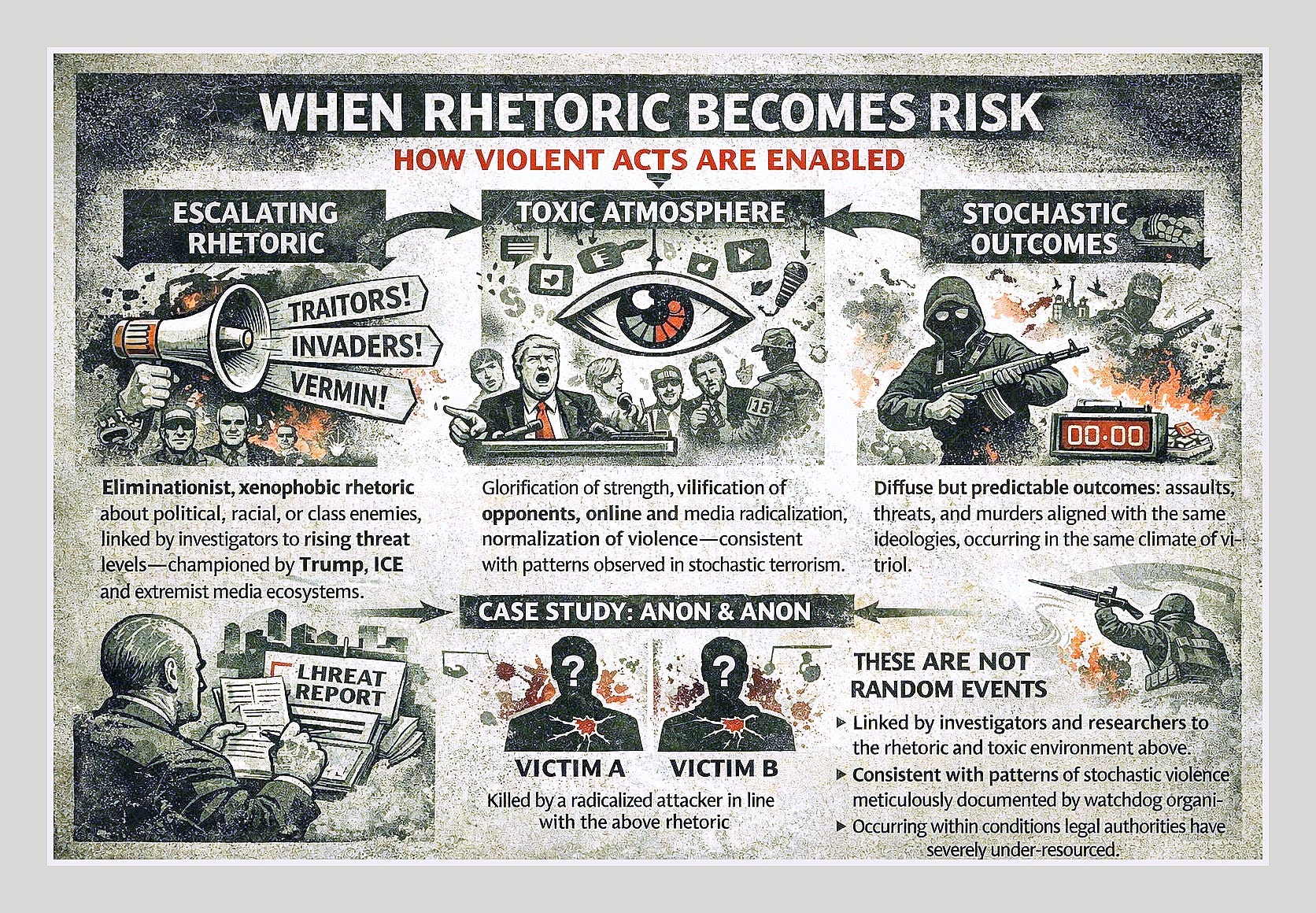
“The system that produced the act remains untouched, like a factory that denies liability for pollution by blaming the smoke.”